
The magnificent website Sidmouth Nature refers extensively to Sidmouth Cemetery, from a dedicated page to related pages on meadows, biodiversity networks and project ideas. And over the last week or so, the creator of this online resource, Peter Orchard, has been adding further pages and information on the Cemetery.
There is a new piece looking at Sidmouth Brownfields, with different categories of ‘intervention’, the Cemetery being all about ‘balance’:
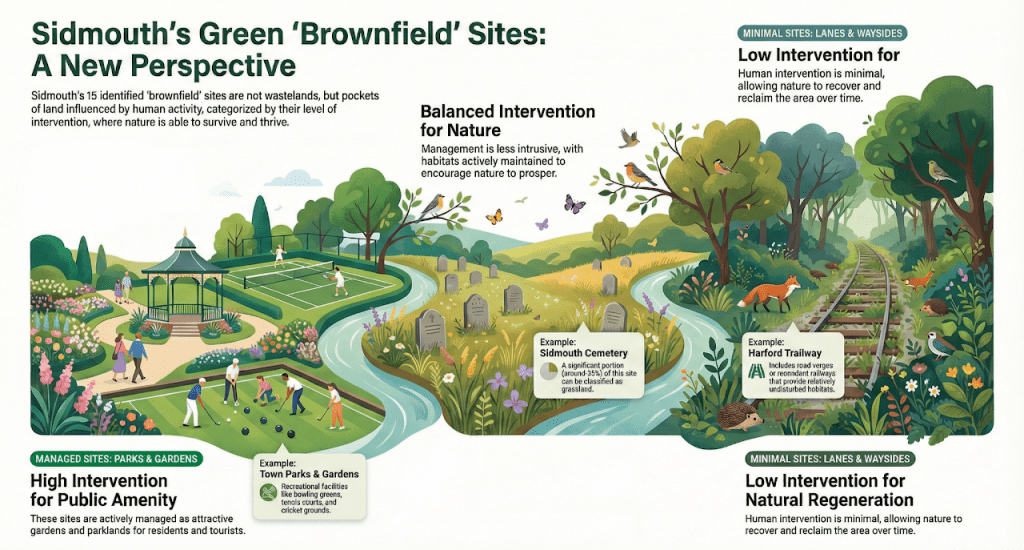
Maintained Sites: The “Half-Wild” Green Spaces
These sites have less human intervention than formal parks. Here, habitat is actively maintained to encourage nature to prosper. Sidmouth Cemetery: A prime example where roughly 25% of the total area is kept as valuable grassland.
A further page takes us to Maintained Sites:
While some brownfield sites are left to grow wild, Sidmouth’s Maintained Sites are those where dedicated groups work to balance human use with ecological health. From historic observatories to community ponds, these sites form a vital network of green corridors.
A “Green Highway”: Covering 10 acres, the cemetery is a “fragment of our ancient landscape”
– Grassland Recovery: By leaving some grass long, species like the Oxeye Daisy have recovered.
– The Hedgerow Network: Ancient hedges act as a “green highway” for foraging Lesser Horseshoe Bats and provide a potential habitat for the rare Hazel Dormouse.
– Stone Habitats: Older gravestones and walls support unique communities of lichens and mosses.
In the updated page on Sidmouth Grasslands, we learn that the Cemetery is ‘a fungal stronghold’:
Sidmouth Cemetery is a unique site managed as a wildflower meadow.
– Fungi Indicators: It is noted for Waxcaps and Fairy Rings, which are indicators of rare, ancient grazing pasture.
– Historical Growth: Because the ground has a history of disturbance, only the areas dating back over 100 years have fully regained these valuable grassland characteristics.
Finally, here’s some data gathered on the Brownfield Biodiversity that found at Sidmouth Cemetery:
It is easy to assume that derelict land or urban parks have little ecological value. However, the data from our Sidmouth survey tells a completely different story. While brownfield sites made up only 30% of the sites surveyed, they hosted a staggering 64.1% of all recorded species.
And at the Cemetery, a total of 143 different species have been recorded in this survey.
…